



Rapid City sits where the pine-covered Black Hills meet the open plains, and homes here face a brutal climate: chinook winds that swing temperatures 50 degrees in a day, 20-below cold snaps, and summer afternoons that push attics past 95°F. Most of the housing stock runs on poured basements, many of them walkouts cut into hillsides, with frame homes and bungalows built in the early 1900s stacked above them. The result is constant air leakage: warm air rising into attics in winter melts snow that refreezes as ice dams along the eaves; cold air seeping in through rim joists and basement walls costs you money every heating season. Air sealing in Rapid City stops that leakage at the source, and spray foam is the tool that does it right. We find the leaks, seal them with precision, and hold the line against the climate that dominates this region.
Why Air Sealing Matters in Rapid City's Climate
In Rapid City, the failure mode is not gradual. A warm attic in winter melts the snowpack on your roof. That water runs down to the eaves where the air is cold and refreezes as ice. The ice dams back up melt water, and water finds its way into the walls and attic framing. A single winter with a bad ice dam can cost thousands in water damage and mold remediation. Air sealing stops the warm air that causes the melt in the first place. The homes around downtown Rapid City and up through Rapid Valley that were built before 1960 often have balloon-framed walls with empty cavities running from basement to attic. Cold air flows straight up through those cavities in winter. The ranches and split-levels built in the 1950s and 1970s in North Rapid and Robbinsdale have rim joists and band joists that were never sealed, and the open cavities leak like chimneys. The newer two-stories in Red Rock Estates and Southgate have heated three-car garages that sit on uninsulated band joists and rim boards. Air sealing fixes all three patterns.
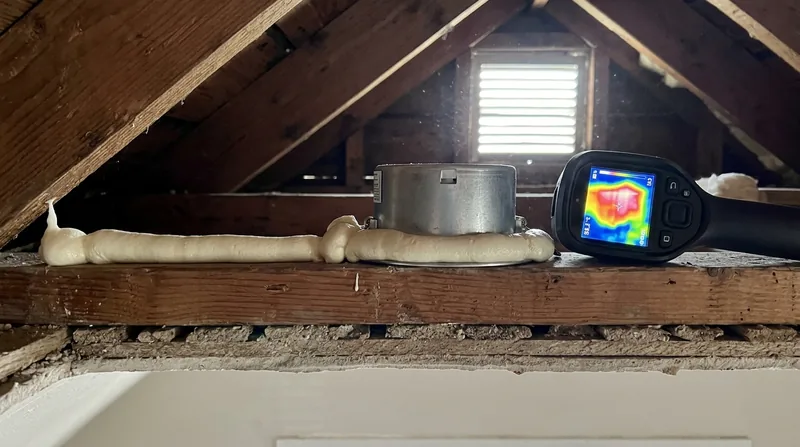
- We identify all major air leakage points: rim joists, band joists, basement rim areas, attic bypasses, and penetrations where utilities pass through walls.
- We seal those leaks with spray foam, which expands to fill gaps and hardens to a solid barrier that does not settle or compress.
- We pay special attention to the attic floor plane, where warm air rises through gaps around electrical wiring, HVAC ducts, and wall top plates.
- We work in winter and summer because air sealing is a year-round problem in Rapid City.
Air sealing is the single biggest credibility differentiator between a professional spray foam contractor and a fiberglass installer. Fiberglass does not stop air movement. Foam does.
Key info: The South Dakota Building Code requires that attic ventilation, ignition barriers, and thermal barriers meet the energy code in force at your address. Verify what applies at your property with your local building department before you hire. We help you navigate the rules, but the building official has the final say.
For more detail on how air sealing pairs with attic spray foam insulation, see our attic page.
How We Perform Air Sealing in Rapid City
Air sealing starts with a walk-through. We look for the big leaks first: the rim joist where the house meets the foundation, the band joist above the basement, the attic floor plane where walls meet the attic, and anywhere utilities or HVAC ducts penetrate framing. In a home in Piedmont or Summerset built in the 1970s, the rim joist is often open to the crawl space below with no insulation at all. In a 1990s home in Sheridan Lake Road or Red Rock, the garage sits on an uninsulated band joist and the heated space above loses heat straight down. In a downtown Rapid City bungalow with balloon framing, we trace the wall cavities and seal the top of the wall where it opens into the attic. Once we have identified the leaks, we apply closed-cell or open-cell spray foam depending on the substrate and the depth of the cavity. Closed cell is our standard for rim and band joists because it is rigid, handles moisture, and does not require a vapor barrier. Open cell works in attic cavities where depth allows and cost is a concern.
- We inspect the rim joist, band joist, and basement rim area for gaps, cracks, and open cavities.
- We identify all penetrations: plumbing vent stacks, electrical conduit, HVAC ducts, and sump pump lines that breach the thermal boundary.
- We prep the substrate by cleaning out debris and confirming it is dry and sound before we spray.
- We apply foam in controlled passes, building thickness to the specification we outlined in your estimate.
- We maintain the correct drum temperature and mix ratio so the foam cures properly and does not shrink or crack.
- We provide mechanical ventilation during cure and specify a re-entry window of 24 to 48 hours.
The process is straightforward, but the details matter. A contractor who skips the ventilation, promises immediate re-entry, or applies foam in one thick pass instead of multiple thin passes is cutting corners. We do not.
Example: A split-level in North Rapid with an open rim joist and exposed band board needed air sealing before the homeowner could add attic insulation. We sealed the rim, the band, and the attic floor penetrations with closed-cell foam. The estimate included R-value and thickness specs. The job took one day. The homeowner saw a noticeable reduction in drafts and a lower heating bill the first winter.
For details on rim joist and band joist air sealing, see our dedicated page.
Air Sealing Methods and Approaches
| Approach | Description | Best for |
|---|---|---|
| Closed-cell spray foam air sealing | High-density foam applied at 1.5 to 2 lb/ft3, expands to fill voids and hardens to a rigid barrier with an R-value around 6 to 7 per inch. | Rim joists, band joists, basement rim areas, and any location where structural support or moisture resistance is needed. |
| Open-cell spray foam air sealing | Lower-density foam applied at 0.5 to 0.7 lb/ft3, expands to fill cavities and remains flexible with an R-value around 3.5 to 4 per inch. | Attic floor bypasses, wall cavities, and interior penetrations where cost sensitivity is high and vapor permeability is acceptable. |
| Caulk and sealant air sealing | Polyurethane caulk or silicone sealant applied to small cracks, gaps around electrical outlets, and minor penetrations. | Detail work, small gaps, and finishing touches after foam application is complete. |
| Gaskets and weatherstripping | Rubber or foam gaskets installed around electrical boxes, ductwork, and other penetrations to block air movement. | Electrical boxes, plumbing penetrations, and HVAC duct sealing in attics and basements. |
Air Sealing Cost in Rapid City: What to Expect
Air sealing in Rapid City typically starts at around $650 for a small rim joist or basement rim area project. Most homes, though, have multiple leak points: the rim joist, the band joist, the attic floor plane, and utility penetrations. A complete air sealing job on a 1,500 square-foot ranch or split-level in North Rapid or Robbinsdale usually runs between $1,500 and $3,500, depending on the scope and the foam type. Homes with larger attics, more complex framing, or multiple rim joists and band joists cost more. A two-story in Red Rock Estates with a heated garage and an open rim board can run $3,000 to $5,000. The main factors that affect cost are the linear footage of rim joist to seal, the number of penetrations to address, the depth and condition of the cavities, and whether the substrate is dry and ready or requires prep work.
We do not spray over wet, contaminated, or leaking surfaces. If we find moisture, we walk away and tell you to fix it first. That is not a cost-cutting move; it is the only honest way to do the job. A wet rim joist or a leaking basement will ruin foam and waste your money.
Get a free estimate from us and one or two other contractors. A real estimate includes the R-value, the thickness, the linear footage or square footage of the work, and the foam type. If a contractor gives you a price without those details, walk away. We provide a written estimate with all specs before we book the job.
See our full pricing page for more detail on how we structure costs for different project types.
Air Sealing Near Me: What to Look for When Hiring a Spray Foam Contractor in Rapid City
Air sealing is a small-ticket job, but it is also the most credibility-sensitive work in the spray foam trade. A bad air sealing job is invisible: the foam is hidden behind walls, in attics, or under basements. You will not see it again until something goes wrong. That is why verification matters. When you call a contractor, ask for a written estimate that includes the R-value per inch, the thickness in inches, the linear footage or square footage, the foam type (closed cell or open cell), and the total price. If the contractor cannot or will not provide those specs, do not hire them. Check that the contractor is fully insured and can provide a certificate of insurance on request. Ask for references from jobs in Rapid City, Box Elder, Spearfish, or Sturgis completed in the last two years. Call those references and ask whether the contractor showed up on time, cleaned up after the job, and whether they were reachable if a question came up after the work was done. Ask whether the contractor addressed permits. In Rapid City and the surrounding cities, permitting rules vary. Some cities require a permit for attic work; others do not. Some have specific rules about ignition barriers or thermal barriers. A good contractor will tell you what applies at your address and help you navigate it. If an HOA covers your property, ask whether exterior work on a metal building or a garage requires architectural approval. Most insulation work happens inside, but if you are sealing a pole barn or a metal structure, check your HOA rules first.
Call us at (605) 519-6148 for a free estimate, or contact us online. We will walk through your home, identify the leaks, and give you a clear price with no surprises.
Air Sealing in Rapid City: Pricing Guide
| Service | Price | Details |
|---|---|---|
| Small air sealing project (rim joist, single penetration area) | Starting at $650 | Includes inspection, foam application, and curing time for one localized leak point or small rim area |
| Moderate air sealing (rim joist plus band joist, multiple penetrations) | Starting at $1,500 | Covers linear footage of rim and band joists, attic floor penetrations, and utility sealing for a typical 1,500 sq ft home |
| Comprehensive air sealing (full basement rim, attic floor plane, all penetrations) | Starting at $2,500 | Complete thermal boundary sealing for a two-story or larger home with multiple leak points and complex framing |
| Complex or large-scale air sealing job | On estimate | Homes with extensive balloon framing, multiple stories, heated garages, or crawl spaces require site inspection for accurate pricing |
| Travel | Included | No separate mileage fee or call-out charge within Rapid City and surrounding service areas |
| Free estimate | Free | Written estimate with R-value, thickness, and detailed specs provided within 24 hours; no obligation to book |
Indicative pricing, the exact cost depends on square footage, finish, and site access. Free personalized estimate within 24h at (605) 519-6148.


