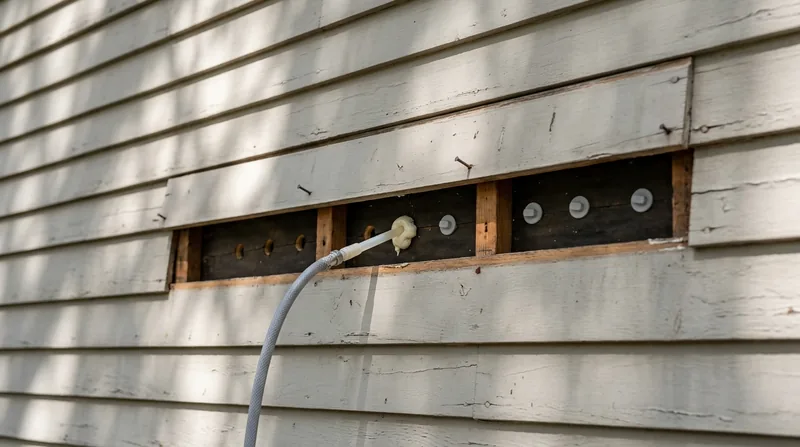




Wall & Injection Foam Insulation in Rapid City fills the cavities in exterior walls of older homes and retrofits uninsulated spaces without demolition. Rapid City's early-1900s frame homes on West Boulevard and the downtown core sit with hollow balloon-framed walls built over empty cavities, while 1950s ranches across North Rapid and Robbinsdale carry rim joists open to the crawl space below. Injection foam reaches into those dead zones, seals air leaks, and raises the R-value of walls that fiberglass batts never reached. In a climate where 20-below cold snaps alternate with chinook winds that swing 50 degrees in a day, that sealed cavity stops the convection loop that pulls warm air into the walls and lets it condense and rot the framing. We drill small holes, inject closed-cell or open-cell foam into the stud bays, and seal the holes. The result is a warmer wall, lower heating cost, and a foundation that stays dry. Call us at (605) 519-6148 for a free estimate, or read about our other services like attic spray foam insulation and air sealing.
Why Wall & Injection Foam Insulation Matters in Rapid City's Older Homes
Rapid City's housing stock tells the story. Downtown and West Boulevard hold 1890s to 1920s frame cottages and bungalows built with balloon framing, a technique where exterior walls run continuous from foundation to roof with no fire breaks, no blocking, and no insulation. The cavities are hollow. A 1950s ranch on the north side or in Robbinsdale may have had cellulose blown into the attic decades ago, but the walls stayed empty, and the rim joist where the floor sits on top of the basement wall is open to the crawl space. When outdoor temperature drops to 20 below and the furnace runs, warm air rises into the attic and leaks out through the roof, but it also infiltrates the walls and the rim, condenses on the cold sheathing, and soaks the wood. Over years, that rot spreads. Injection foam stops that cycle. It fills the cavity completely, blocks air movement, and holds the wall at a temperature closer to the interior. The Black Hills climate drives this hard: the semi-arid winters are cold and dry, but a chinook wind can warm the outdoor air 50 degrees in six hours, and that rapid pressure change pushes moisture outward through the walls. Sealed cavities shed that vapor.
- We drill 1-inch holes into the rim, band joist, or wall cavity at 16-inch intervals, inject closed-cell or open-cell foam, and patch the holes with foam plugs and caulk.
- Closed-cell foam is denser, carries an R-value of 6 to 6.5 per inch, and resists moisture and vapor drive better than open-cell.
- Open-cell foam is lighter, cheaper, and reaches an R-value of 3.5 to 4 per inch, and is used when vapor permeability is an asset or when the budget is tight.
- The holes are small and easily patched, so the exterior appearance of the home does not change.
- Work is fast, usually completed in a single day, and the foam cures hard within 24 hours so the wall is immediately stronger and more insulated.
Injection foam is the only way to insulate an existing wall cavity without tearing out drywall or siding.
Key info: Homes on West Boulevard and downtown Rapid City with 1900s frame construction are prime candidates. A two-story 1920s cottage with exterior walls that are cold to the touch in winter, or a basement rim joist that sweats in summer, tells you the cavity is empty and ready for foam. We inspect first, drill test holes if needed, and quote the job based on the linear feet of cavity and the foam type.
See our guide to rim joist and band joist spray foam for more detail on that specific application.
How We Inject Foam Into Walls: The Process in Rapid City
Injection foam work starts with a site visit. We measure the wall, identify the stud cavity layout, and determine whether the cavity is truly empty or partially filled with old insulation, electrical wiring, or plumbing. We drill small test holes to confirm cavity depth and width. Then we set up our rig, position the injection port, and pump foam at controlled pressure and temperature. The foam expands slightly, fills the cavity edge to edge, and hardens. We pull the injection port, insert a foam plug, and patch the hole with caulk and paint or siding match. A typical wall section on a Rapid City ranch or cottage takes 4 to 8 hours depending on the linear footage and the number of cavities.
- We visit the site, measure the wall cavity, and drill a small test hole to confirm depth and existing fill.
- We set up injection equipment with closed-cell or open-cell foam in sealed drums at the manufacturer's specified temperature.
- We drill injection ports at 16-inch intervals along the cavity, insert the injection gun, and pump foam at controlled pressure until the cavity is full.
- Foam cures hard in 24 hours, and we patch all holes with foam plugs, caulk, and paint or exterior match.
- We verify R-value and thickness on the estimate and document the work with photos and a written scope.
The entire process is contained indoors, and mechanical ventilation during cure keeps the work area safe for the homeowner and any occupants. We ask for a 24-hour re-entry window after cure is complete.
Local example: A 1950s split-level in Robbinsdale with a cold rim joist and a basement that stays damp: we inject closed-cell foam into the rim cavity, which seals the air gap between the heated house and the cold basement. The cavity temperature rises, the rim stays dry, and the basement no longer sweats in summer. Cost runs from $2 to $3 per linear foot depending on cavity depth and foam type.
Learn more about how closed-cell spray foam handles moisture and vapor drive in the Black Hills climate.
Injection Foam Methods & Approaches
| Approach | Description | Best For |
|---|---|---|
| Closed-Cell Injection | High-density foam injected into cavities; R-value 6 to 6.5 per inch; resists moisture and air infiltration; cures hard and rigid. | Rim joists, band joists, exterior walls in damp or high-vapor climates, and any wall where moisture control is critical. |
| Open-Cell Injection | Lower-density foam injected into cavities; R-value 3.5 to 4 per inch; cures soft and flexible; allows vapor permeability. | Interior walls in conditioned spaces, sound dampening, and budget-conscious retrofits where vapor drive is outward year-round. |
| Cavity-Fill (Partial Injection) | Foam injected to fill only the upper or lower portion of a cavity when structural or utility obstacles prevent full fill. | Walls with existing wiring, plumbing, or HVAC ducts that cannot be moved; common in 1950s-70s ranches. |
| Retrofit Over Existing Insulation | Foam injected into cavities that already hold old fiberglass, cellulose, or mineral wool; fills voids and adds R-value. | Older homes where original insulation has settled or compressed; increases effective R-value without full removal. |
Wall & Injection Foam Insulation Cost in Rapid City: What to Expect
Injection foam pricing in Rapid City starts at $2 to $4 per linear foot of cavity, depending on the foam type, cavity depth, and the number of injection points. A typical 1,500-square-foot 1950s ranch with an uninsulated rim joist running 120 linear feet might cost $240 to $480 for rim joist injection alone. A two-story 1920s cottage with balloon-framed exterior walls and multiple cavities will run higher because there are more injection points and more linear footage. Closed-cell foam costs more per linear foot than open-cell because it carries a higher R-value and resists moisture better, but it is the right choice for rim joists, band joists, and exterior walls in Rapid City's semi-arid climate with outward vapor drive. Open-cell foam is cheaper and is used in interior walls or when the budget is the primary driver.
The biggest variable is cavity depth and the number of injection ports needed. A 2-inch rim joist cavity needs fewer ports than a full 3.5-inch stud cavity. Accessibility matters too: a rim joist that sits 4 feet above grade is faster to work on than one buried under a deck. We drill test holes before quoting so we can see what we are working with. Get 2 to 3 estimates from local contractors so you can compare foam type, R-value, thickness, and workmanship warranty. The cheapest estimate is often the one with no specification of R-value or thickness, no written scope, and no insurance verification. We provide written estimates with R-value and thickness specs, and we are fully insured.
For a full breakdown of pricing and options, visit our pricing page or call (605) 519-6148 for a free estimate.
Wall & Injection Foam Insulation Near Me: What Rapid City Homeowners Should Know When Hiring
When you are looking for a spray foam contractor to inject walls or rim joists in Rapid City, Spearfish, Sturgis, or the surrounding Black Hills area, start by verifying that the contractor is fully insured and can provide a certificate of insurance. Ask for a written estimate that names the foam type (closed-cell or open-cell), the R-value per inch, the expected thickness, and the linear footage being treated. A reputable contractor will also specify the curing time, the re-entry window, and whether the work requires any permit from your local building department. Rapid City's building official can tell you whether injection foam work in your address requires a permit; it varies by location and by the scope of work. If you own a home in a master-planned community or under an HOA, check the architectural guidelines to confirm that interior wall work is permitted (exterior work on metal buildings or visible modifications may be restricted).
- Ask the contractor whether they are fully insured and request a certificate of insurance before work begins.
- Demand a written estimate that specifies foam type, R-value per inch, expected thickness, and the total linear footage or square footage being treated.
- Verify that the contractor understands the local building code and permitting rules by asking them to name the Rapid City building official or the city where your home is located.
- Check references from at least two previous jobs in Rapid City or the surrounding area, and ask whether the homeowner experienced any smell, cure time issues, or performance problems after the work was completed.
- Never accept a price quote with no R-value, no thickness specification, and no workmanship warranty in writing.
- Confirm the re-entry window (typically 24 to 48 hours) and whether the contractor will provide mechanical ventilation during cure to manage odor and off-gassing.
A local contractor with a local address, local insurance, and a track record in Rapid City is your best protection against the rig-and-run outfits that spray in an afternoon and disappear when the smell will not go away or the foam fails to cure properly.
Call us at (605) 519-6148 or visit our contact page to request a free estimate and speak with someone who knows the Black Hills climate and Rapid City's housing stock.
Wall & Injection Foam Insulation in Rapid City: Pricing Guide
| Service | Price | Details |
|---|---|---|
| Closed-Cell Injection Foam | Starting at $3/linear foot | High R-value, moisture-resistant; rim joists, band joists, and exterior walls in damp climates demand this type |
| Open-Cell Injection Foam | Starting at $2/linear foot | Lower R-value but cheaper; interior walls and sound dampening applications where vapor permeability is an asset |
| Cavity-Fill Retrofit (Partial) | Starting at $2.50/linear foot | Foam injected around existing wiring, plumbing, or ducts; common in 1950s-70s ranches and older homes with obstacles |
| Full Wall or Rim Joist Injection | On estimate | Linear footage, cavity depth, foam type, and access determine final cost; test holes and site visit included in free estimate |
| Estimate | Free | Written proposal with R-value, thickness, and linear footage; response within 24 hours at (605) 519-6148 |
Indicative pricing, the exact cost depends on square footage, finish, and site access. Free personalized estimate within 24h at (605) 519-6148.


