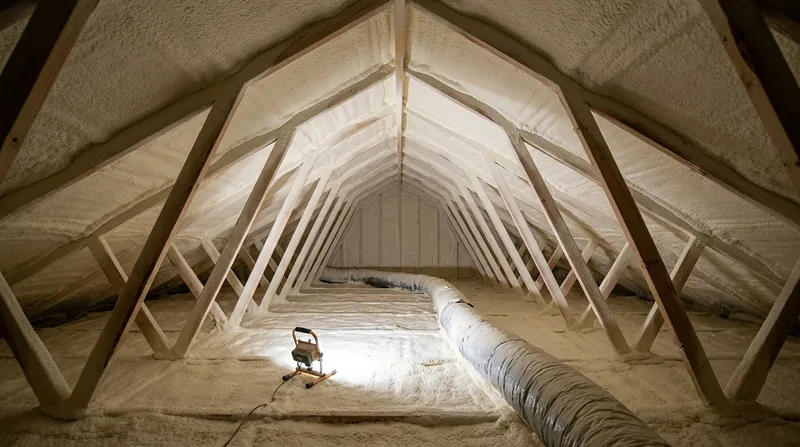




Rapid City sits where the pine-covered Black Hills meet the open plains, and homes here face one of the most demanding attic climates in the region. Summer afternoons push 95 degrees while winter cold snaps drop to 20 below, and the notorious chinook winds swing temperatures 50 degrees in a single day. That thermal shock, combined with snow melt and refreeze cycles, creates ice dams along eaves and drives warm, moist air into attics where it condenses and leaks. Attic spray foam insulation in Rapid City stops that air leakage at the source, seals rim and rafter connections that fiberglass never reaches, and creates a conditioned or semi-conditioned space that eliminates the temperature swings that destroy roofs. Whether your home is a 1900s balloon-frame bungalow on West Boulevard, a 1950s ranch in North Rapid, or a newer two-story in Southgate, the physics are the same: air leaks cost money, and spray foam seals them. We have been doing this work since 2012, and we know what fails in Rapid City attics and why.
Why Attic Spray Foam Insulation Matters in Rapid City's Climate
Rapid City's geography creates a perfect storm for attic failure. The Black Hills cast long shadows that cool roofs in winter, but the same roofs face direct sun in spring and fall when ground snow is still present. That temperature differential melts snow at the roof line while the eaves stay cold, pushing water under shingles and into attic framing. At the same time, warm interior air escapes through gaps in ceiling drywall, rim joists, and around ductwork, carrying moisture that condenses on cold framing. Fiberglass batts and blown-in cellulose cannot stop this air movement, so the problem persists year after year. Spray foam air sealing stops warm air before it reaches the cold roof, and closed cell foam on the roof deck creates a thermal and moisture barrier that works even when the attic is vented.
- We seal every air leak at the rim, rafter heel, and chase cavity so warm air cannot escape into the attic.
- We apply foam to the roof deck or the attic floor depending on whether you want to condition the space or leave it vented.
- We remove failed insulation, old fiberglass, or deteriorated cellulose before we spray, so the new foam adheres to solid framing.
- We specify R-value and thickness in writing so you know exactly what you are getting and what it costs to maintain code compliance at your address.
- We respect attic ventilation codes and ignition barriers as they apply to your home, and we defer to your local building department on every detail.
Getting these details right is what separates a job that stops ice dams from one that just looks like it did.
Key info: Rapid City homes built before 1980 often have balloon-framed walls and attics filled with original cellulose or fiberglass that has settled, compacted, or absorbed moisture over decades. A top-up with spray foam stops the air leaks that fiberglass alone cannot seal, and it does so without tearing out the old insulation unless it is wet or contaminated. Check with the Rapid City Building Department at (605) 394-4141 to confirm what R-value and thermal barrier requirements apply to your address.
How We Install Attic Spray Foam Insulation in Rapid City
Our process starts with a site visit to understand your attic layout, framing condition, existing insulation, and what your building code requires. We measure board footage, identify air leaks, and check for moisture, roof leaks, or contamination that must be addressed before foam is sprayed. If your attic has failed insulation or standing water, we do not spray over it. We fix the moisture first or we walk away. Once the substrate is clean and dry, we bring in our spray rig and apply foam in controlled passes, maintaining the manufacturer ratio and drum temperature so the foam cures to full density and R-value. Mechanical ventilation runs during the cure to clear isocyanate vapors, and we provide a re-entry window of 24 to 48 hours before you occupy the space.
- We inspect the attic and identify all air leaks, moisture sources, and existing insulation condition before quoting.
- We remove old insulation, debris, or contaminated material if it is in the way of the foam or if it poses a risk to the new work.
- We seal rim joists, rafter heels, chase cavities, and ductwork penetrations with closed cell foam so no warm air escapes.
- We spray the attic floor or roof deck with open cell or closed cell foam depending on your climate, ventilation, and R-value target.
- We provide a written estimate with R-value, thickness in inches, board footage, and the thermal barrier specification that applies to your address.
- We coordinate with your local building department on permits, ventilation, and inspections as required by code.
This methodical approach takes longer than a one-day spray-and-leave job, but it is the only way to guarantee the foam cures correctly and performs as specified.
Example: A 1,800 square foot ranch home in Robbinsdale with a vented attic and settled fiberglass had chronic ice dams along the north eave. We sealed the rim joists and rafter heels with closed cell foam, then added 4 inches of open cell foam over the attic floor to reach R-30. The air sealing stopped the warm air leakage that was melting snow on the roof, and the homeowner saw no ice dams the following winter. Total cost was within budget because we identified that a simple air seal was the real problem, not a full attic replacement.
| Approach | Description | Best for |
|---|---|---|
| Closed Cell on Roof Deck | 1.5 to 2 inch closed cell foam sprayed directly on roof sheathing, creating an unvented conditioned attic with high R-value and moisture control. | Sealed attics in Rapid City where ventilation is blocked by construction or where you want to condition the entire space; eliminates ice dams and condensation. |
| Closed Cell on Rim and Rafter Heel | Targeted 1 to 2 inch closed cell foam applied to rim joists and rafter heel connections, sealing the primary air leak path while leaving attic floor open for additional insulation. | Vented attics where air sealing is the priority and budget is tight; works well as a top-up over existing insulation. |
| Open Cell on Attic Floor | 3 to 6 inch open cell foam sprayed over attic floor joists, providing R-value and air sealing at lower cost than closed cell; allows vapor to pass through. | Vented attics in Rapid City where R-value is the goal and budget is moderate; semi-conditioned attics where some vapor transmission is acceptable. |
| Hybrid (Closed Cell Rim plus Open Cell Floor) | Closed cell foam at rim and rafter heel for air sealing and moisture control, combined with open cell foam on the floor for R-value and cost balance. | Vented attics where air sealing and R-value are both important and budget allows a two-step approach; common in retrofit work. |
Attic Spray Foam Insulation Cost in Rapid City: What to Expect
Attic spray foam insulation in Rapid City typically starts at $1.50 per square foot for open cell foam on the floor of a straightforward vented attic, and ranges up to $3.00 to $4.00 per square foot for closed cell foam on a roof deck or for a complex retrofit with multiple air sealing zones. A typical 1,500 square foot attic with rim and rafter heel sealing plus open cell floor insulation runs $2,000 to $4,500 depending on framing complexity, existing insulation removal, and local code requirements. Closed cell work on a roof deck costs more because the material is more expensive, application is more precise, and the finished job carries higher R-value per inch. The biggest cost variables are attic access, whether old insulation must be removed, the number of penetrations and chase cavities that need sealing, and whether your local building department requires an ignition barrier or thermal barrier upgrade. Get two or three written estimates from contractors who specify R-value, thickness, and board footage in writing, and do not trust a price that is significantly below market without understanding why. For a detailed breakdown of pricing for your specific situation, visit our full pricing overview or call (605) 519-6148 for a free on-site estimate.
What to Look for When Hiring a Spray Foam Insulation Contractor Near Me in Rapid City
Hiring a spray foam contractor is a significant decision, and the difference between a competent installer and a poor one shows up years later in utility bills, moisture damage, and odor complaints. A good contractor will provide a written estimate with R-value and thickness specified in inches, will explain why they are recommending closed cell or open cell foam for your specific situation, and will answer your questions about ventilation, thermal barriers, and code compliance. They will be fully insured and will provide proof of coverage. They will not promise energy savings as a percentage or a dollar amount, will not claim a lifetime warranty, and will not rush you into a decision. They will tell you what permits are required at your address by naming the Rapid City Building Department or your city's equivalent, and they will help you navigate what applies. They will also walk away from a job if the substrate is wet, contaminated, or unsafe to spray over. Avoid any contractor who gives you a price with no R-value or thickness, who promises immediate re-entry into the attic, who cannot verify insurance, or who quotes a price far below market without a clear explanation. Check references with homeowners in Box Elder, Spearfish, or Sturgis if possible, and verify that the contractor is still reachable if a question comes up after the job is done. For a free estimate with no obligation, contact us here or call (605) 519-6148.
Attic Spray Foam Insulation in Rapid City: Pricing Guide
| Service | Price | Details |
|---|---|---|
| Open Cell Foam on Attic Floor | Starting at $1.50/sq ft | Vented attic application, 3 to 6 inches, includes air sealing of rim and rafter heel connections, cost varies with removal of old insulation |
| Closed Cell on Rim and Rafter Heel | Starting at $2.00/sq ft | Targeted air sealing in vented attics, 1 to 2 inches, highest priority leak paths, works as a top-up over existing insulation |
| Closed Cell on Roof Deck (Unvented Attic) | Starting at $3.00/sq ft | Sealed conditioned attic, 1.5 to 2 inches, eliminates ice dams and condensation, includes thermal barrier per code at your address |
| Hybrid Approach (Closed Cell Rim plus Open Cell Floor) | Starting at $2.25/sq ft | Air sealing plus R-value in vented attics, combines materials for cost and performance balance, includes removal of failed insulation if present |
| Insulation Removal (if required) | On estimate | Wet, contaminated, or asbestos-suspect material requires professional assessment and safe disposal before new foam is applied |
| Free Estimate and Site Visit | Free | Response within 24 hours, includes R-value and thickness specification in writing, no obligation to book, call (605) 519-6148 |
Indicative pricing, the exact cost depends on square footage, finish, and site access. Free personalized estimate within 24h at (605) 519-6148.


