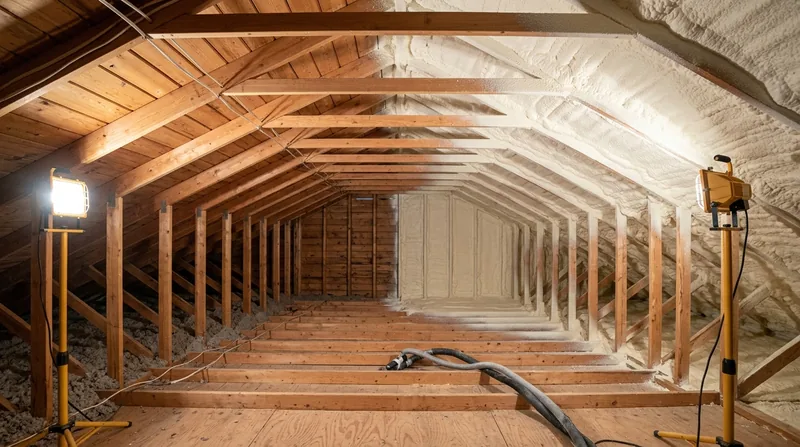




Insulation Replacement & Re-Insulation in Rapid City is not a luxury upgrade for most homeowners here; it is a necessity born of climate and time. The Black Hills and plains surrounding Rapid City see chinook winds that swing temperatures fifty degrees in a day, ice dams that form when warm air leaks into attics and melts snow that refreezes along the eaves, and semi-arid cold that pushes vapor outward through walls and crawl spaces year-round. Homes built in the 1950s and 1960s across North Rapid, Robbinsdale, and the older frame neighborhoods downtown often carry insulation that has settled, compressed, or failed entirely. When R-value drops below code, energy bills climb, condensation collects, and the building envelope stops working. We remove the old material, seal air leaks, and install spray foam or blown-in insulation to restore thermal control and comfort. This page explains why replacement matters in Rapid City, how the process works, and what to expect when you call.
Why Insulation Replacement Matters in Rapid City's Extreme Climate
Rapid City sits at the edge of the Black Hills where ponderosa pines give way to open prairie, and that geography means temperature swings, wind load, and moisture pressure that punish old or failed insulation. A 1960s ranch in North Rapid with original fiberglass batts has likely seen those batts compress to half their original thickness, losing R-value and allowing warm air to leak into the attic on a 20-below night. That air hits the cold roof deck, condenses, and soaks the framing. In summer, a 95-degree afternoon in the attic drives vapor down through the ceiling into the living space below. Homes with balloon-framed walls, common in the early-1900s bungalows downtown and on West Boulevard, often have empty cavities or mineral wool that has settled to the bottom, leaving cavities above with almost no thermal resistance. Crawl spaces under hill-cut walkouts and split-levels in Rapid Valley collect moisture from the soil and the seasonal water table, and old insulation batts hanging from the rim joist absorb that moisture and fail. Replacement stops the leak, restores the R-value, and controls the moisture.
- Compressed or settled insulation loses R-value and allows air leakage that drives heating and cooling costs higher.
- Moisture-soaked insulation in crawl spaces and rim joists loses thermal resistance and promotes rot in wood framing.
- Ice dams along the eaves form when warm air leaks into the attic and melts snow; replacement and air sealing prevent the leak at the source.
- Old mineral wool, cellulose, or fiberglass in walls can settle unevenly, leaving cold spots and drafts in living spaces.
- Replacement is the only way to restore the original R-value and meet current energy code for your address.
When you replace failed insulation, you are not just adding thickness; you are stopping the air leakage and vapor drive that the original material could not handle.
Key info: A typical 1960s attic in a Robbinsdale or North Rapid home started with 3 to 4 inches of fiberglass. After 60 years of settling and moisture, that attic is now at R-10 or below. Current code in Rapid City requires R-38 to R-49 depending on your heating fuel and the building official. Replacement brings it into compliance and cuts air leakage by sealing the rim, the band joist, and the attic hatch.
For more on how moisture and air leakage interact in the attic, see our page on Attic Spray Foam Insulation.
How Insulation Replacement Works: Step by Step
Replacement begins with inspection and measurement. We enter the attic, crawl space, or wall cavity, photograph the existing material, measure depth and coverage, and note any moisture, mold, or pest damage. We then estimate the volume of material to remove, identify air leaks, and recommend the replacement method: spray foam for sealed attics and rim joists, blown-in for open attics where ventilation must be preserved, or injection foam for closed walls. Once you approve the estimate and any required permits are in place, we schedule the work. Removal comes first, using a vacuum truck to pull out old insulation or hand-removal if the space is tight. Then we air-seal with foam or caulk, install baffles if needed, and apply the new insulation to the specified R-value and thickness. Interior work can proceed in winter when outdoor temperatures make attic spray foam cure slowly; exterior work in summer is faster but requires mechanical ventilation during cure.
- We inspect the existing insulation, measure depth and R-value, and photograph conditions including any moisture or pest activity.
- We provide a written estimate with R-value, thickness, and the method best suited to your attic, crawl space, or wall cavity.
- We remove old insulation using a vacuum truck or hand-removal, depending on the material and access.
- We seal air leaks at the rim joist, band joist, attic hatch, and any ductwork or penetrations before installing new insulation.
- We install spray foam, blown-in, or injection foam to the specified R-value, with mechanical ventilation during cure if required by code.
- We verify coverage and thickness, clean up debris, and provide a warranty certificate and re-entry window before you occupy the space.
The entire process, from estimate to completion, typically takes one to three weeks depending on permit timelines and job complexity.
Example: A walkout basement in Rapid Valley has a 1970s rim joist insulated with fiberglass batts that are now black with mold and dripping with moisture from the soil outside. We remove the batts, dry the rim framing, seal the concrete band with closed-cell foam to stop vapor and air leakage, and install new batts or foam to R-20. The basement no longer sweats, the framing dries, and the heating bill drops because warm air no longer leaks through the rim into the crawl space.
See our Insulation Removal page for details on the vacuum and hand-removal process.
Replacement Methods: Spray Foam, Blown-In, and Injection Foam
| Method | Description | Best For |
|---|---|---|
| Closed-Cell Spray Foam | High-density foam applied at 1.5 to 2 lbs per cubic foot, R-6 per inch, acts as vapor barrier and air seal in one step. | Rim joists, crawl space rim beams, sealed attics, metal buildings, and any space where vapor and air control are critical. |
| Open-Cell Spray Foam | Lower-density foam at 0.5 lbs per cubic foot, R-3.5 per inch, allows vapor to pass through, requires separate thermal barrier. | Attics with ventilation, vaulted ceilings, and sound-dampening applications where moisture must not be trapped. |
| Blown-In Fiberglass or Cellulose | Loose-fill material pneumatically applied to achieve target R-value, allows air circulation, lower cost per board foot. | Open attics with existing ventilation, top-up of sound existing insulation, and cost-sensitive retrofits where air sealing is done separately. |
| Injection Foam | Low-pressure foam injected into closed wall cavities through small holes, fills voids without demolition. | Pre-1980 frame homes with empty or partially filled wall cavities, balloon-framed walls, and retrofit work where walls must remain intact. |
The choice depends on the space, the existing ventilation, the moisture profile, and your budget. A sealed attic can use open-cell foam to save cost and allow vapor to dry to the interior if needed. A crawl space or rim joist must use closed-cell to stop vapor and provide structural rigidity. An open attic with good ventilation can use blown-in to achieve R-38 or R-49 at lower cost. A 1920s bungalow in downtown Rapid City with empty balloon-framed walls gets injection foam to fill the cavities without tearing into the walls.
Insulation Replacement & Re-Insulation Cost in Rapid City: What to Expect
Insulation replacement cost in Rapid City ranges from $2,800 to $8,000 or more depending on the size of the space, the existing material, and the replacement method. A 1,200 square-foot attic in a North Rapid ranch with settled fiberglass might cost $3,500 to $5,000 to remove and replace with blown-in or open-cell foam to R-38. A crawl space under a walkout basement with moldy batts and moisture damage might run $4,000 to $7,000 because the rim joist must be sealed with closed-cell foam and the substrate dried first. Wall injection in a downtown bungalow with two stories of empty cavities could be $5,000 to $10,000 depending on wall area and the number of injection points. Travel within Rapid City and the surrounding service area is included; no separate mileage fee applies.
Several factors move the price up or down. A large attic with multiple roof sections, dormers, or a complicated layout takes longer to seal and insulate. Moisture or pest damage requires drying or remediation before foam can be applied. Access matters: a low attic with tight joists costs more to work in than a spacious one. The existing material also affects cost; asbestos-containing insulation or vermiculite requires special handling and referral to a licensed professional. Closed-cell foam costs more per board foot than blown-in, but it provides vapor control and structural support in one step, which can justify the price in crawl spaces and rim joists.
We provide a written estimate with R-value, thickness, and labor at no charge. The estimate is your baseline; the final invoice reflects the actual square footage and any conditions found during removal. To see typical pricing ranges and examples, visit our pricing page.
What to Look for When Hiring an Insulation Replacement Contractor Near Rapid City
Hiring a spray foam or insulation contractor near Rapid City requires the same care as any major home repair. Start by asking for references and checking them; a contractor who has been in business since 2012 and has completed work in Deadwood, Lead, Hill City, and Box Elder can point you to homeowners whose attics or crawl spaces you can inspect. Get at least two or three estimates, and make sure each one includes R-value, thickness, and labor. Be wary of a quote with no R-value or thickness specified; that is a sign the contractor does not understand the job or does not plan to verify coverage after installation. Ask about insurance and get a certificate of insurance before work begins; do not accept a verbal promise that coverage exists. If your home is in a historic district or an HOA area, check what permits or approvals are required for exterior work or mechanical ventilation during cure. The city building department in Rapid City, Box Elder, Spearfish, or Sturgis can tell you what applies at your address.
- Ask for references from homeowners in Rapid City, Box Elder, or Hill City whose insulation was replaced in the last two years.
- Request a written estimate with R-value per inch, target thickness in inches, and the square footage or board footage being replaced.
- Verify that the contractor carries full insurance and can provide a current certificate naming you as additional insured during the work.
- Ask how the contractor will verify coverage and thickness after installation; a reputable installer measures and photographs the work.
- Confirm whether permits are required at your address and who obtains them; the building official, not the contractor, decides what is required.
- Discuss the re-entry window if spray foam is used; typically 24 to 48 hours before the space is occupied, and mechanical ventilation will run during cure.
A contractor who answers these questions clearly, provides references, and gives you a detailed estimate is one you can trust to do the work right. Call us at (605) 519-6148 for a free estimate, or visit our contact page to request an inspection.
Insulation Replacement & Re-Insulation in Rapid City: Pricing Guide
| Service | Price | Details |
|---|---|---|
| Attic insulation replacement (up to 1,200 sq ft) | Starting at $2,800 | Removal of old insulation, air sealing, and blown-in or open-cell foam to R-38; larger attics and complex layouts cost more |
| Crawl space rim joist and band replacement | Starting at $3,200 | Removal of wet or moldy batts, drying, closed-cell foam sealing, and new insulation; moisture remediation increases cost |
| Wall injection foam retrofit (per 1,000 sq ft of wall) | Starting at $4,500 | Injection of low-pressure foam into empty or partially filled cavities without demolition; two-story homes and multiple walls cost more |
| Complex or large-scale replacement | On estimate | Multi-story homes, sealed attics with multiple roof sections, or crawl spaces with structural or moisture issues require on-site inspection |
| Travel and site visit | Included | No separate mileage or call-out fee within Rapid City and surrounding service areas; free estimate within 24 hours |
| Free estimate | No obligation | Written quote with R-value, thickness, and labor; call (605) 519-6148 or use contact form to schedule |
Indicative pricing, the exact cost depends on square footage, finish, and site access. Free personalized estimate within 24h at (605) 519-6148.


