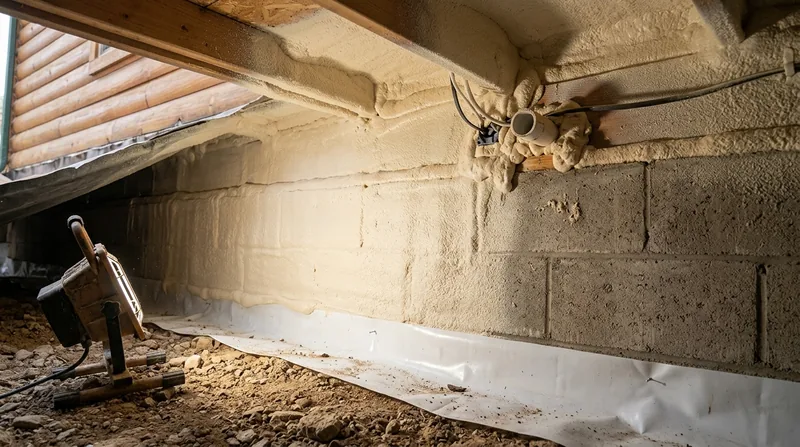




Crawl Space Spray Foam Insulation in Rapid City solves the problem that most homeowners never see until the heating bill arrives or the floor above stays cold no matter how high the thermostat climbs. Rapid City sits where the Black Hills meet the prairie, and the terrain cuts hard: many homes sit on poured basements, but the cabins, older frame houses, and seasonal properties scattered across Hill City, Deadwood, Lead, and the surrounding foothills rest on crawl spaces. Those spaces sit between the earth and the living floor, exposed to the semi-arid cold that drops below 20 degrees in winter and to the vapor drive that pushes outward most of the year. Uninsulated or poorly insulated crawl spaces leak warm air, frost the rim and band joists where the house meets the foundation, and let humidity and cold travel straight into the rooms above. Spray foam seals and insulates in one pass, stops the air leakage, and protects the structure from the moisture swings that dominate this climate.
Why Crawl Space Insulation Matters in Rapid City's Climate
The Black Hills region experiences sharp seasonal swings: 20-below winters, chinook winds that swing temperatures 50 degrees in a single day, and a semi-arid atmosphere where vapor pressure pushes outward through most of the year. A crawl space without insulation or air sealing becomes a cold sink that pulls heat down from the floor above and lets moisture accumulate on band joists, rim boards, and the rim band where the foundation meets the frame. Over time, this cycle weakens the structure, drives up heating costs, and creates conditions that lead to wood rot and structural decay. Spray foam insulation with a continuous air seal stops that cycle by creating a thermal and moisture barrier between the crawl space and the living space above.
- Eliminates cold drafts rising through the floor and into the rooms above, especially in older frame homes with balloon framing or open rim construction.
- Seals rim and band joists where most crawl space air leakage occurs, preventing warm air from escaping and cold from entering.
- Reduces the vapor drive that pushes moisture into wood framing during Rapid City's dry winters and variable spring and fall transitions.
- Protects the structural integrity of band joists and rim boards by keeping them warmer and drier, reducing the risk of rot and decay.
- Lowers heating costs by preventing the crawl space from acting as a thermal sink that drains warmth from the floor above.
These benefits compound in Rapid City because the climate is unforgiving: the combination of cold, low humidity, and the occasional wet spring creates conditions where an uninsulated crawl space becomes a weak point in the whole thermal envelope.
Local example: A 1960s ranch in Robbinsdale with an open crawl space and no rim insulation loses heat through the floor even when the basement feels warm. Spray foam on the rim and band joists, combined with air sealing at the rim detail, stops that loss and brings the floor temperature up by 8 to 12 degrees in winter. See how we approach rim joist and band joist insulation for more detail on this critical junction.
For guidance on what applies to your crawl space in Rapid City, consult the South Dakota Building Code and Standards Division, which governs energy code and thermal barrier requirements at your address.
How We Insulate Crawl Spaces in Rapid City: Step by Step
The work starts with an honest assessment of what is already there: existing fiberglass, cellulose, or open cavities; the condition of rim and band joists; moisture or standing water; and the crawl space ventilation (if any). We never spray over wet substrate, contaminated insulation, or active moisture. If the space needs drying or removal of failed insulation first, we handle that before foam goes in. Once the space is clean and dry, we measure the rim detail, the band joist cavity, and the rim board thickness, then specify the closed cell or open cell foam type and thickness needed to meet code R-value requirements for your address.
- Inspect the crawl space, test for moisture, and identify any existing insulation that needs removal or improvement.
- Remove old insulation, debris, or contaminated material if required, leaving a clean, dry substrate for foam application.
- Set up mechanical ventilation during the spray process to manage vapors and ensure safe working conditions.
- Spray closed cell or open cell foam to the specified thickness and R-value, paying special attention to the rim and band joist detail where air leakage is highest.
- Complete the thermal barrier (if required by code) and verify coverage, thickness, and proper adhesion before the space is re-entered.
- Provide written documentation of R-value, thickness, and foam type, plus a clear re-entry window of 24 to 48 hours.
The entire process typically takes one to three days depending on crawl space size and access, with the bulk of the work concentrated in the rim and band joist detail.
Real Rapid City example: A log cabin in Hill City with a crawl space on a slope had 1980s fiberglass that had settled and compressed, leaving the rim completely exposed. We removed the old insulation, sealed and insulated the rim with closed cell foam (2 inches, R-13), and wrapped the band joist detail. The owners reported that the floor above stopped feeling cold within a week, and the crawl space humidity stabilized. This is typical work for seasonal properties in the Hills.
For more on how we integrate crawl space work with the rest of the thermal envelope, see our approach to air sealing throughout the home.
Spray Foam Methods for Crawl Spaces: Open Cell vs. Closed Cell
| Approach | Description | Best for |
|---|---|---|
| Closed Cell Spray Foam | Dense, rigid foam with an R-value around 6 to 7 per inch. Provides a vapor barrier and air seal. Low permeability, resists moisture. | Crawl spaces in Rapid City where moisture control and structural support are priorities, especially rim and band joist details exposed to vapor drive. |
| Open Cell Spray Foam | Lightweight, softer foam with an R-value around 3.5 per inch. Breathable, allows vapor transmission. Lower density, easier to cut and trim. | Crawl spaces where vapor management is less critical and cost is a priority. Rarely the first choice in Rapid City's semi-arid climate due to moisture risk. |
| Insulation Removal + Closed Cell | Complete removal of failed or settled fiberglass, cellulose, or old foam, followed by new closed cell foam application to code R-value. | Older homes in Robbinsdale, North Rapid, and the Hills where original insulation has degraded or compressed and rim is exposed. |
| Rim and Band Joist Detail Only | Targeted 2 to 3 inch closed cell foam applied only to the rim and band joist cavity, leaving existing crawl space insulation in place if sound. | Homes where the main heat loss is at the rim, existing insulation is adequate, and budget favors a focused air sealing approach. |
In Rapid City's climate, closed cell foam is the standard choice for crawl spaces because it delivers both insulation and vapor resistance in one material, and the rim detail is where most of the air leakage and moisture risk occurs. Open cell is rarely recommended for crawl spaces in this region unless the space is already well-controlled and the budget is the limiting factor.
Crawl Space Spray Foam Insulation Cost in Rapid City: What to Expect
Crawl space spray foam insulation starts at $2,500 for a small space with straightforward rim and band joist work in Rapid City proper. The final cost depends on the size of the crawl space, the linear feet of rim and band joist that need insulation, whether existing insulation must be removed first, and the foam type and thickness required to meet code R-value for your address. A 1,500 square foot home with a 50-foot rim perimeter and 2 inches of closed cell foam typically runs $3,500 to $5,500. Larger homes, spaces with complex geometry, or jobs that require insulation removal can reach $6,000 to $8,000 or more. The only way to know your cost is to get a written estimate with R-value and thickness specs.
We provide free estimates within 24 hours at (605) 519-6148. The estimate includes a site walkthrough, a measurement of the rim detail, specification of foam type and thickness, and a firm price range for your specific crawl space. Multiple estimates from different contractors are always smart, so you can compare approach, material choice, and warranty terms.
For a full pricing overview and to see how crawl space work fits into the broader range of spray foam services we offer, visit our pricing page.
What to Look for When Hiring a Spray Foam Contractor Near Rapid City
When you call a spray foam contractor for a crawl space estimate, ask for and verify three things: proof of current general liability insurance (not just a verbal claim), references from completed crawl space or rim joist jobs in the Rapid City area, and a written estimate that names the foam type (closed cell or open cell), the R-value, and the thickness in inches. A contractor who cannot or will not provide these details, or who quotes a price far below market with no inspection, is cutting corners. Ask whether the estimate accounts for insulation removal, whether mechanical ventilation will be used during the spray, and what the re-entry window is (24 to 48 hours is standard). Choose a contractor who explains the re-entry time and gives you a realistic, inspection-based estimate of the work.
Permitting varies by city in Greater Rapid City, so ask your contractor to confirm what applies at your address and to help you navigate the local building department if a permit is required. Some jurisdictions require notification of spray foam work; others do not. The building official at your city or county will tell you. HOA rules rarely touch insulation but may govern exterior work on metal buildings or additions in master-planned areas like Red Rock Estates or Southgate, so check your covenants if you live in a community with architectural review.
For a free estimate and a contractor who will answer these questions directly, contact us today. We are fully insured, we provide written estimates with R-value and thickness specs, and we will walk through the process with you step by step.
Crawl Space Spray Foam Insulation in Rapid City: Pricing Guide
| Service | Price | Details |
|---|---|---|
| Rim and Band Joist Insulation Only | Starting at $2,500 | Closed cell foam on rim detail, 2 to 3 inches, for homes with adequate existing crawl space insulation and focused heat loss at the rim. |
| Full Crawl Space Insulation | Starting at $3,500 | Rim, band joist, and crawl space cavity insulation with closed cell foam, typical 1,500 square foot home, no removal required. |
| Insulation Removal + Spray Foam | Starting at $4,500 | Complete removal of failed or settled fiberglass or cellulose, followed by new closed cell foam to code R-value, typical 1,500 square foot home. |
| Large Crawl Space or Complex Geometry | On estimate | Multi-level crawl spaces, steep terrain, or large square footage require on-site measurement and specification before a firm price can be quoted. |
| Travel | Included | No separate mileage or travel charge for Rapid City and surrounding service areas including Hill City, Deadwood, and Box Elder. |
| Free Estimate | Free | Response within 24 hours at (605) 519-6148, includes site walkthrough, measurement, foam type and thickness specification, no obligation to book. |
Indicative pricing, the exact cost depends on square footage, finish, and site access. Free personalized estimate within 24h at (605) 519-6148.


